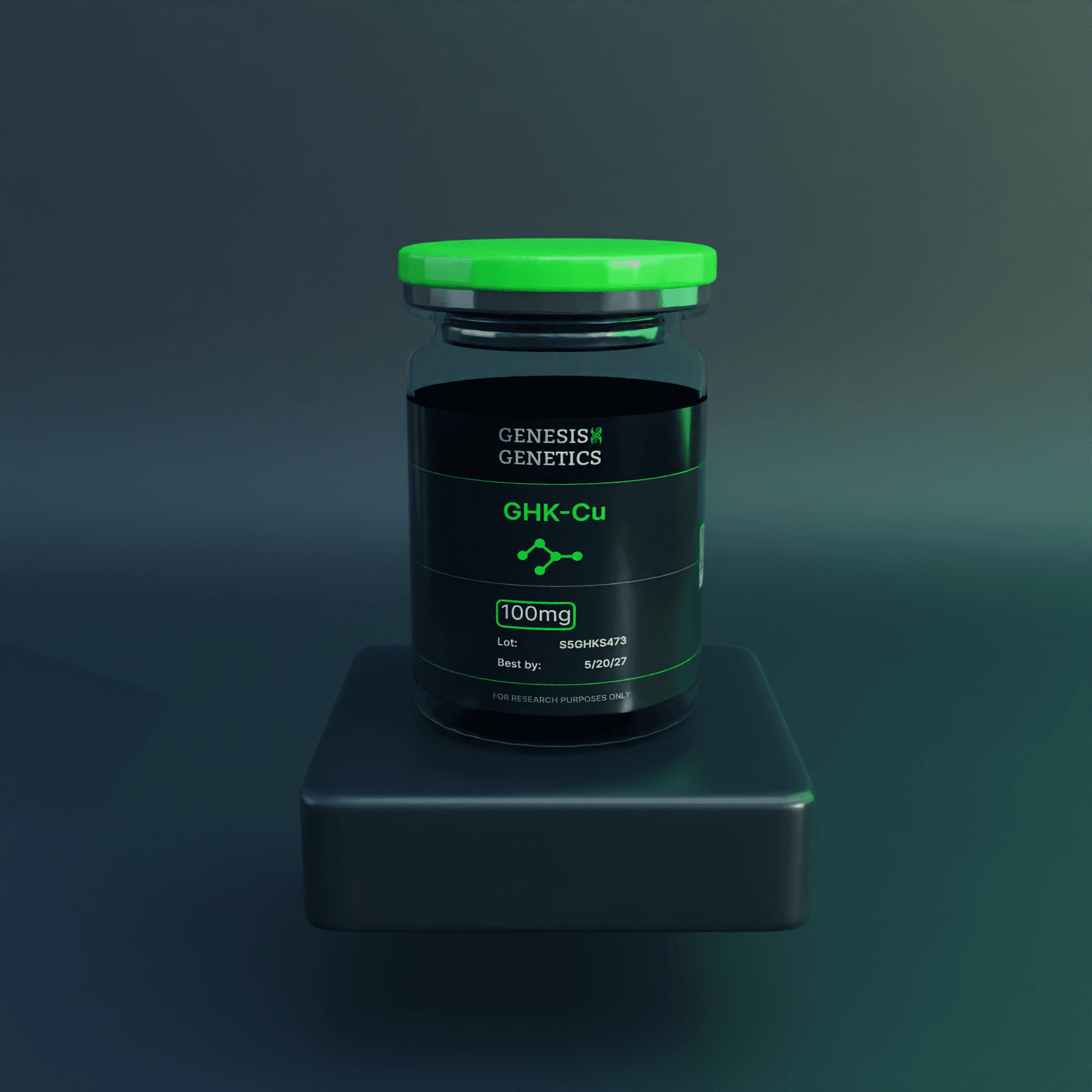
GHK-Cu
Also known as: Copper Peptide GHK, Glycyl-L-histidyl-L-lysine copper
GHK-Cu is a naturally occurring copper-binding tripeptide with well-documented effects on wound healing, collagen and elastin synthesis, angiogenesis, and antioxidant enzyme upregulation in research models.
Structure
Tripeptide Gly-His-Lys + Cu(II)
Molecular Weight
340.4 Da (peptide); 403.9 Da (Cu complex)
Endogenous Source
Human plasma, saliva, urine
Discovery
Pickart, 1973
Primary Targets
Fibroblasts, ECM, SOD, lysyl oxidase
Research Use Only
Not for human or veterinary use
Overview
GHK-Cu (glycyl-L-histidyl-L-lysine copper complex) was first isolated from human plasma by Pickart in 1973. It is a naturally occurring tripeptide that forms a stable complex with copper(II) ions and circulates in human blood, saliva, and urine. Plasma concentrations of GHK decline with age — from approximately 200 ng/mL in young adults to around 80 ng/mL in those over 60 — a pattern that has motivated research into its role in tissue maintenance and repair.
The most extensively documented research applications of GHK-Cu relate to wound healing and dermal tissue remodeling. In cell culture and animal models, GHK-Cu has been shown to stimulate fibroblast proliferation, collagen and glycosaminoglycan synthesis, and the activity of matrix metalloproteinases involved in remodeling aged or damaged extracellular matrix. Studies by Pickart and colleagues, as well as subsequent independent groups, have documented accelerated closure of full-thickness wounds in rodent models.
Beyond structural protein synthesis, GHK-Cu research has revealed effects on antioxidant defense systems. The peptide upregulates superoxide dismutase (SOD) and has been investigated for its role in modulating the ubiquitin-proteasome system to promote clearance of damaged proteins. This combination of pro-synthetic and antioxidant actions has generated interest in GHK-Cu as a model compound for studying the biology of cellular senescence and tissue aging.
GHK-Cu is available for laboratory and research use only. A substantial body of peer-reviewed literature — spanning skin biology, wound healing, neurotrophic factor research, and gene expression analysis — provides a rich foundation for investigators designing experiments in these areas.
Mechanism of Action
GHK-Cu exerts its effects through multiple pathways. The copper component participates in redox reactions and is essential for lysyl oxidase activity, which cross-links collagen and elastin. The peptide carrier facilitates cellular copper uptake and activates downstream signaling cascades, including those involving cAMP and protein kinase A, that modulate gene expression in fibroblasts.
Microarray studies have demonstrated that GHK-Cu influences the expression of over 4,000 genes, with notable effects on pathways related to ECM synthesis, proteasome function, and growth factor signaling (including TGF-β, VEGF, and PDGF). Its antioxidant effects involve upregulation of superoxide dismutase and catalase, providing a mechanistic basis for its observed protective effects in oxidative stress models.
Research Applications
- Wound healing and dermal fibroblast biology
- Collagen and extracellular matrix synthesis studies
- Copper biology and metallopeptide research
- Antioxidant enzyme upregulation models
- Senescence and cellular aging research
- Hair follicle and angiogenesis studies
Research Use Only. GHK-Cu is available for laboratory and research applications only. It is not approved by the FDA or any equivalent regulatory authority for human or veterinary therapeutic use. All information on this page is derived from published preclinical literature and is presented for informational and research context purposes only. Investigators should consult current primary literature and comply with applicable regulations before initiating research.
Order GHK-Cu for Research →Peptide Family
Tissue Repair Peptides
Structural Protein Synthesis · Angiogenesis · Wound Healing
All Compound Research Overviews