Growth Hormone Secretagogues
GHRH Receptor · GH/IGF-1 Axis · GH Secretagogue Research
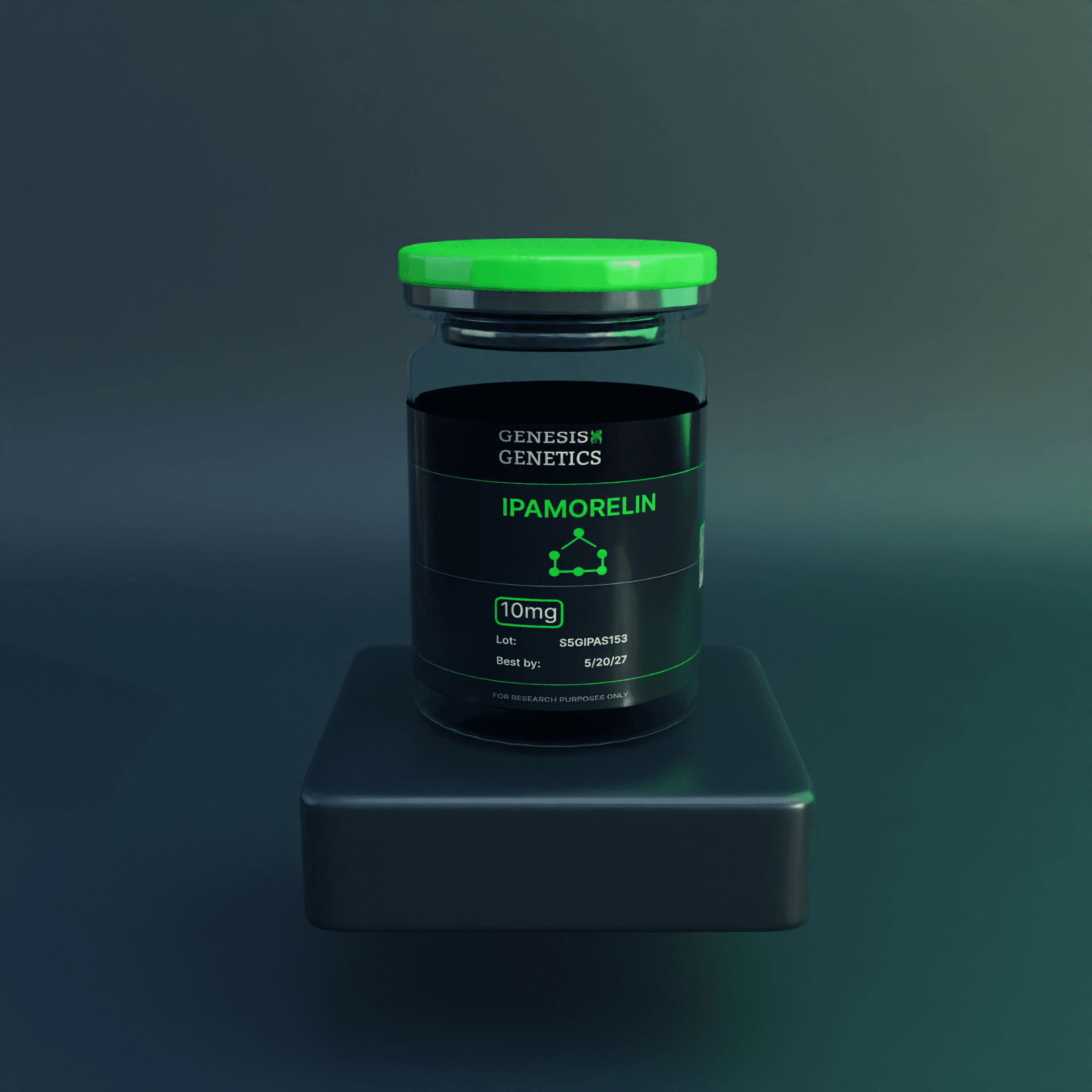
The growth hormone secretagogue (GHS) family encompasses research compounds that stimulate or mimic the actions of endogenous hormones governing growth hormone release. At Genesis Genetics, this family includes Ipamorelin (a selective GHSR-1a agonist), CJC-1295 with DAC (a long-acting GHRH receptor agonist), Tesamorelin (a GHRH(1-44) analog with clinical precedent), and AOD9604 (an hGH C-terminal fragment targeting fat metabolism without GH receptor binding).
Compounds in This Family
CJC-1295 with DAC
Overview
These compounds occupy distinct positions in the GH axis pharmacology space. Ipamorelin acts downstream of the hypothalamus at the GHSR-1a receptor on pituitary somatotrophs, mimicking ghrelin's GH-releasing effect with high selectivity. CJC-1295 with DAC and Tesamorelin act upstream by mimicking GHRH at the GHRH receptor. AOD9604 stands apart as a fragment of mature hGH that does not bind the GH receptor but retains lipolytic activity through β-adrenergic and PPAR-γ pathways.
For researchers designing GH axis studies, the pharmacokinetic diversity of this family is particularly useful: Ipamorelin has a short half-life suitable for pulsatile dosing studies, CJC-1295 with DAC has a ~7-day half-life for sustained axis activation studies, and Tesamorelin falls between these extremes with established human pharmacodynamic data from clinical trials. AOD9604 enables study of GH-related fat metabolism without the confounds of IGF-1 elevation.
Research Themes
Pituitary Somatotroph Biology
Ipamorelin's high selectivity for GHSR-1a without co-activation of ACTH or prolactin axes makes it an ideal pharmacological probe for isolated somatotroph biology. Research comparing ipamorelin, GHRP-2, and GHRP-6 has been instrumental in characterizing GHSR-1a receptor subtypes and downstream signaling pathways. Both GHSR-1a and GHRHR agonists in this family provide complementary access points for studying pituitary GH secretion.
Pharmacokinetic Engineering in Peptide Research
The comparison between Tesamorelin (~30 min half-life), Ipamorelin (~2 hr half-life), and CJC-1295 with DAC (~7 day half-life) in terms of GH release kinetics offers researchers a natural pharmacokinetic ladder for studying how GH pulse frequency versus mean GH concentration differentially affects downstream IGF-1 elevation, tissue growth, and metabolic outcomes.
Adipose Tissue and Body Composition
AOD9604 and Tesamorelin have both been studied in the context of visceral adipose reduction, through distinct mechanisms. Tesamorelin achieves this indirectly through elevated GH and IGF-1 acting on GH-receptor-rich visceral adipocytes. AOD9604 achieves it directly through β3-adrenergic and PPAR-γ pathways independent of GH receptor binding. This mechanistic difference makes the two compounds useful controls for one another in adipocyte biology research.
Compound Research Overviews
Frequently Asked Questions
What distinguishes a GHRH analog from a GHSR agonist for research purposes?+
GHRH analogs (CJC-1295, Tesamorelin) act on the GHRH receptor on pituitary somatotrophs, mimicking the hypothalamic signal. GHSR-1a agonists like Ipamorelin mimic ghrelin's action on the same somatotrophs but through a different receptor. They share the downstream outcome of GH release but have distinct binding sites, selectivity profiles, and co-activation patterns. Combining both classes in research allows study of additive or synergistic effects on GH secretion.
Why doesn't AOD9604 elevate IGF-1 like other GH-related peptides?+
AOD9604 is a C-terminal fragment of hGH (residues 176-191) that lacks the N-terminal domain required to bind the GH receptor (GHR). Since IGF-1 production requires GHR binding in the liver, AOD9604 does not trigger the hepatic IGF-1 response. Its lipolytic effects are mediated through β3-adrenergic receptors on adipocytes, making it useful for studying fat metabolism independently of the GH/IGF-1 axis.
Are these compounds approved for research use in animal models?+
These compounds are sold for laboratory and research applications only, and their use in animal research is subject to applicable institutional animal care and use committee (IACUC) protocols at the investigator's institution. They are not approved for human or veterinary therapeutic use.
Research Use Only. All compounds in the Growth Hormone Secretagogues family are sold for laboratory and research applications only and are not approved for human or veterinary therapeutic use. Information presented on this page is derived from published preclinical and clinical research literature and is provided for educational and scientific context only.
Other Peptide Families